
The Things We Leave Behind
The stories hidden inside the things we keep.

There is a picture hanging in my father’s office that has been quietly following me for most of my life.
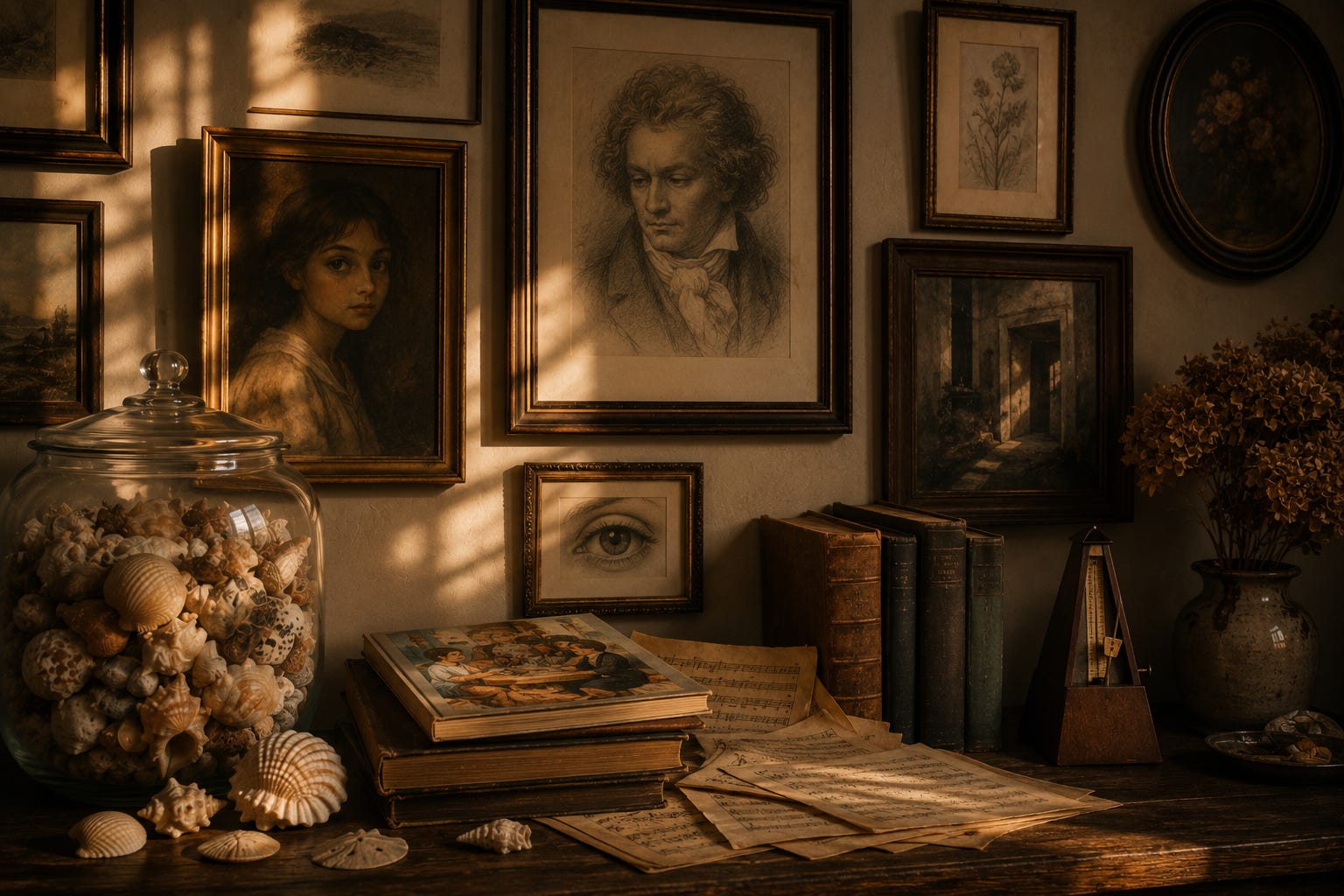
His office has always been moody. Darker than the rest of the house. The kind of room where you could imagine a glass of whiskey sitting beside a leather-bound book, even though my father doesn’t really drink. When I was growing up, he worked from home part-time, and I would wander in to talk to him while he sat facing his computer. Behind him was the printer, and perched on top of it was a teddy bear my sister and I had made for him at Build-A-Bear Workshop. A soft, stuffed interruption in a room that otherwise seemed determined to take itself seriously.
Above the printer hung a framed sketch. I had seen it before. I know I had. But when you’re a child, you don’t really pay attention to everything. Except, somehow, you do.
You absorb rooms without realizing you’re storing them away. You know which chair belongs to which person. You remember the hum of an old television, the things you’re allowed to touch, the things you instinctively know not to. You remember a teddy bear balanced on a printer and the exact wall a picture hung on, even when entire years of your childhood eventually blur around the edges.
That day, I looked at the picture. Really looked at it.
It looked like Darth Vader.
At least, that’s what I thought. The face was shadowed and severe, his expression almost angry. He looked a little frightening to me, so I asked my dad what it was.
“Beethoven.”
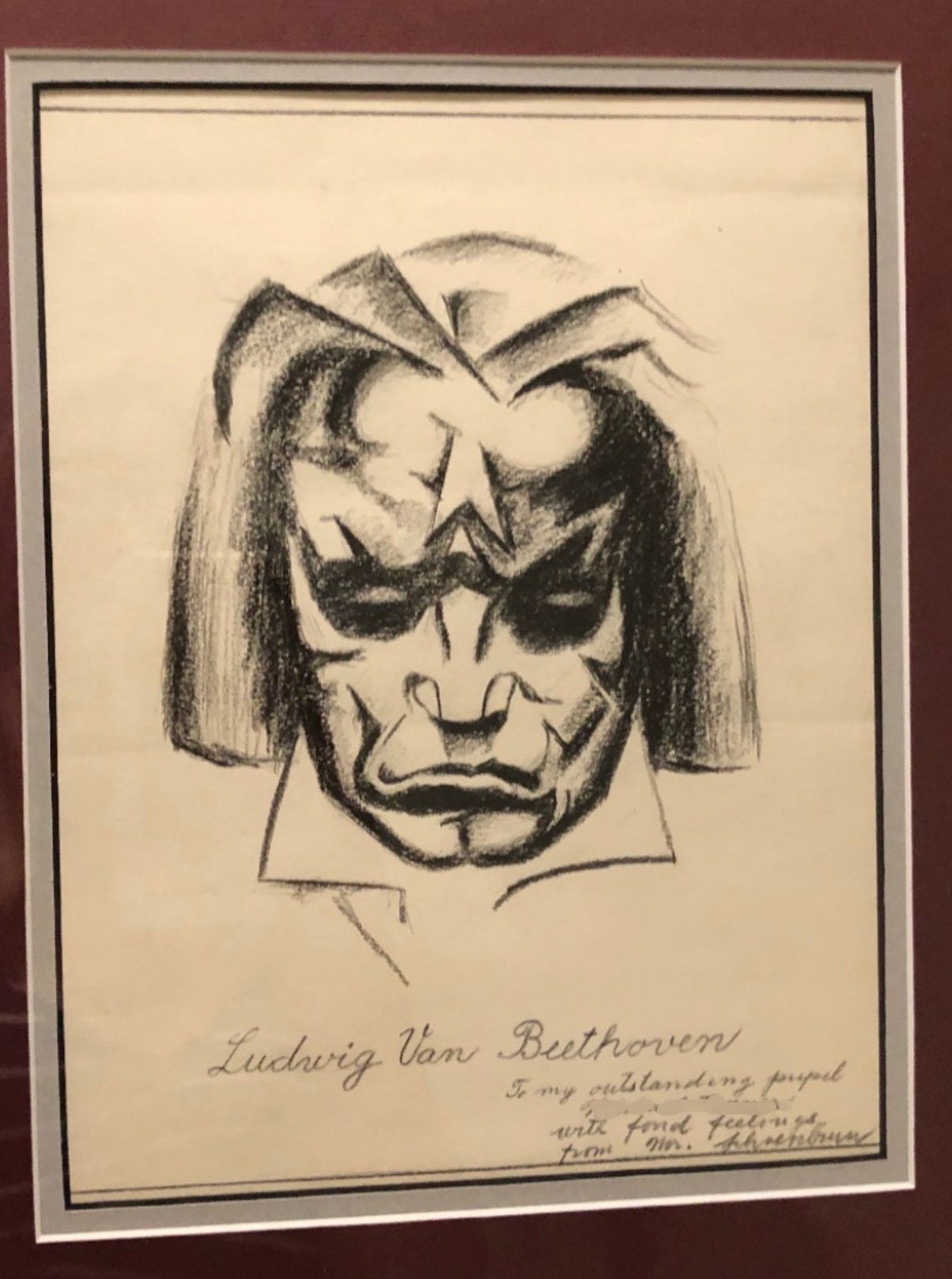
I was little. I didn’t really know who Beethoven was. In my mind, he was a pianist. Someone who sat at a piano and made beautiful music. So why did he look so angry?
“My Hebrew teacher gave it to me,” my dad explained. “When I was a boy, I studied Hebrew before my bar mitzvah. My teacher survived a concentration camp.”
I didn’t understand the weight of those words yet. I didn’t know what a concentration camp was, and I was still too young to understand the world hidden inside it. My father didn’t hand me the whole story that day. He gave me a corner of it, just enough for the little girl standing beside his printer.
As I grew older, more of the picture came into focus. The story didn’t change. I did. I learned enough to return to it with new questions, and every time I did, my father gave me another piece. The story grew with me because my understanding finally had somewhere to put it.
I read Anne Frank in school. Until then, the Holocaust had been made of words too large for me. War. Camps. Millions. I knew the numbers were meant to tell me how enormous the loss was, but I was too young to understand how to hold that many lives in my mind.
Anne Frank’s diary gave one of those lives a voice I could hear.
She wrote down her thoughts. She noticed people. She got frustrated. She dreamed about a future. Her story did not make the scale of the Holocaust easier to comprehend, but it gave my young mind one human life to stand beside while I tried.
The numbers told me how many lives were lost. Her story helped me understand that every number had once been a life.
I understood enough to know I could never fully understand, but I had learned enough to ask more questions. As I got older, my father told me more too.
“My Hebrew teacher told me the Nazis played Beethoven over the loudspeakers every day at Dachau.”
My father has always been a musician. Never as a career, but music has been part of him for as long as I can remember. His Hebrew teacher knew that. He knew my father admired Beethoven.
And still, this was the picture he chose to give him.
I looked at the picture again. The same face stared back at me. The same dark pencil lines. The same frame. The same wall.
But I was no longer the same person standing in front of it.
I think that was the beginning of my understanding that something could be beautiful to one person and almost unbearable to another. The same music. The same composer. The same notes floating through the air.
One person might close their eyes and hear beauty. For another, those same notes had become a death tune. A song for the Grim Reaper. Music woven into hunger, terror, and the constant fear that the next death might be their own.
How could he ever hear Beethoven and simply hear Beethoven again? The music may have belonged to the world, but what had been done with it now belonged to him.
I never listen to Beethoven the same way again.
I have returned to that picture over and over throughout my life. Each time, I carried a little more knowledge with me, a little more history, a little more understanding. The picture remained exactly where it had always been, but somehow it kept becoming something new. It grew with me.
Only in the last few years have I finally found the word for what it had been teaching me all along: perspective.
Once you learn that a picture on a wall can hold an entire story, it becomes harder to pass another without wondering what it has been quietly carrying.
I started noticing the art people lived beside.
…
When I think about the art I noticed as a child, I always end up back in a different room: my grandparents’ living room.
Their living room sat immediately to the right of the entryway. Grandpa’s recliner was near the window, permanently claimed in the way certain chairs become part of a person. He was old-school and already old for as long as I can remember. He died when I was sixteen at ninety-three, and I honestly don’t remember ever knowing him with teeth. My sister and I called him Grandpa No Teeth. He usually sat in his recliner bossing someone around, which, from what I remember, may have been one of his primary hobbies.
My grandfather collected shells whenever he went to the beach. He carried them home and tucked them into the display tables around the living room. There wasn’t much for my sister and I to play with at my grandparents’ house, so the shells became entertainment. We counted them. Rearranged them. Examined the ridges and spirals of things my grandfather had bent down somewhere far away and decided were worth bringing home.
And above us were those eyes.
A little girl holding a cat and a little boy holding a dog. I know there were other things in the paintings. I know that now. But as a little girl, I barely saw them. All I saw were the eyes.
They were enormous. Dark. Almost too large for their faces. They didn’t feel like eyes you could glance at and then look away from. They held you there. The longer I stared into them, the less they felt like part of a painting. There was something almost unnerving about the way they seemed to reach beyond the wall and find me.
The longer I stared into them, the more I felt like I wasn’t the one doing the looking.
They weren’t watching me. They were inviting me. There was something in those eyes that felt like an invitation into a place I didn’t have words for yet, almost an invitation to my soul. As if they were asking me to come closer, to notice something, to find whatever was hiding behind them.
It felt impossible not to stare back.
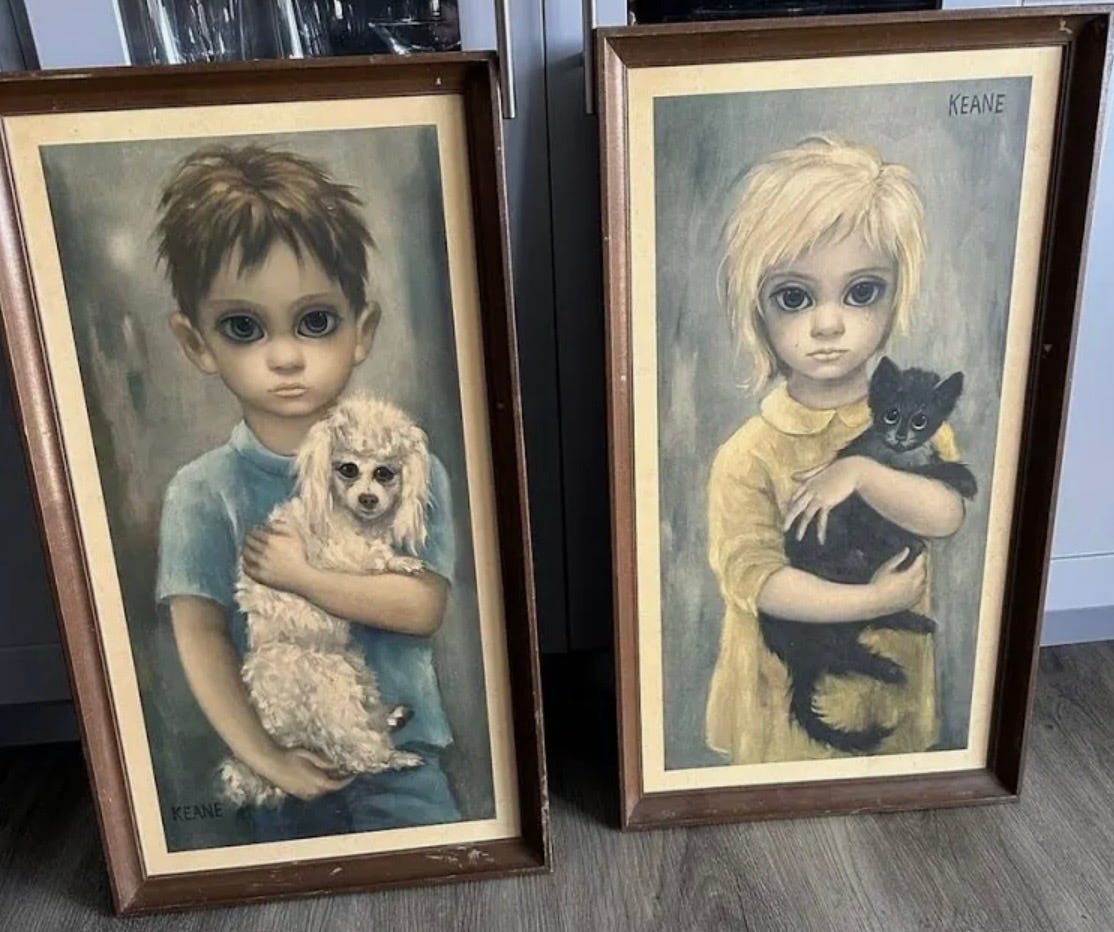
And, because I was still a child, my mind eventually went somewhere much more practical. My grandparents had three children, two girls and one boy. There was a girl on the wall. There was a boy.
So where was the other girl?
In my little-girl logic, someone was missing. Of course I asked myself this.
I can’t remember if I ever asked my grandparents why they chose those paintings. I think there was a conversation, but memory is strange that way. I can walk through the room perfectly in my mind. I know where Grandpa sat. I know where the window was. I can see the old television across the room and the shells scattered through the tables.
I can see the eyes, but some of the words have disappeared.
Years later, I learned the paintings were the work of Margaret Keane, and I did what I often do when something catches hold of my curiosity. I went looking.
I wanted to understand what my grandparents had seen. Why those paintings? Why those faces? What made them choose those enormous eyes to keep watch over their living room?
The more I read, the stranger the story became. For years, Margaret Keane wasn’t publicly known as the artist behind much of her own work. Her husband took credit for the paintings. Her paintings became recognizable while the woman creating them disappeared behind someone else’s name.
I remember sitting with the irony of that. Those eyes. Those enormous, impossible-to-ignore eyes.
I had spent my childhood feeling as though they were asking me to look closer. And when I finally did, I found a woman who hadn’t been fully seen.
The woman behind the eyes had been hidden. Of course she had.
Even the paintings that had spent my childhood silently asking me to look closer were carrying something beneath the surface.
I wasn’t able to keep the originals from my grandparents’ home. They went to another family member. I still hope someday I will find the same paintings and hang them in my own house. These are surprisingly expensive pieces of art.
For years, I thought I wanted the paintings.
I think I miss the room.
I miss the shells beneath my fingers. The old television in the corner. My sister sitting on the floor beside me. I even miss Grandpa No Teeth planted in his recliner, directing the room like a slightly grumpy train conductor. He always wore a train conductor hat.
I don’t know why. He was a farmer.
The paintings can’t give me that room back. I know that. But some small part of me still believes they might crack the door open for a second.
Maybe that’s what we are really asking of the things people leave behind. Not to bring anyone back. Just to help us remember the way there.
Somewhere along the way, I started bringing pieces of those rooms into my own home. A few of my grandmother’s Norman Rockwell plates hang on my walls now. They don’t match anything, and I don’t care. I know what room they came from and every time I look at them I am instantly brought back.
But one piece of art didn’t come from a room I remembered.
It came from a story I inherited.
My father’s mother began drawing it while she was pregnant with him. A little boy opening a book, with characters spilling from the pages as though the story itself could no longer stay contained.
She didn’t finish it before my father was born, and then life did what life does. My father was born. He grew up. The unfinished drawing remained unfinished. Years passed around it.
Before I was born, my grandmother returned to it. She finished the drawing.
Then I was born a girl.
She held onto it.
She kept it, thinking perhaps the next baby would be a boy. She signed and dated it, eventually framed it, and gave it to my parents. The next baby was my sister, so the drawing waited again.
It waited with my father through my childhood and my sister’s. It moved through houses and survived the ordinary passing of years, tucked away while the rest of us kept growing.
No one knew it was waiting. Maybe the drawing didn’t either.
But fifty-seven years after my grandmother first put pencil to paper, the little boy she had drawn finally found his room.
My first son was born, and my dad asked if I wanted the drawing. I didn’t hesitate. I don’t remember ever seeing it before, and I didn’t know its story yet. I only knew my grandmother had drawn it, and that was enough for me to want it.
The story came later. It always seems to.
When I finally learned where the drawing had begun, the lines became something entirely different. My grandmother had drawn them while carrying my father. Her hand had moved across that paper while he was still growing inside her.
Then my father had protected it. Not ceremoniously. He didn’t place it in a museum or beneath glass with a plaque explaining its importance. He simply kept it for twenty-seven years, through all the time when it didn’t seem to belong anywhere.
Then, decades after his mother first put pencil to paper, my father placed it into my hands when I had a son of my own.
It felt like love moving from my grandmother to my father, from my father to me, and from me to my children. Generational love.
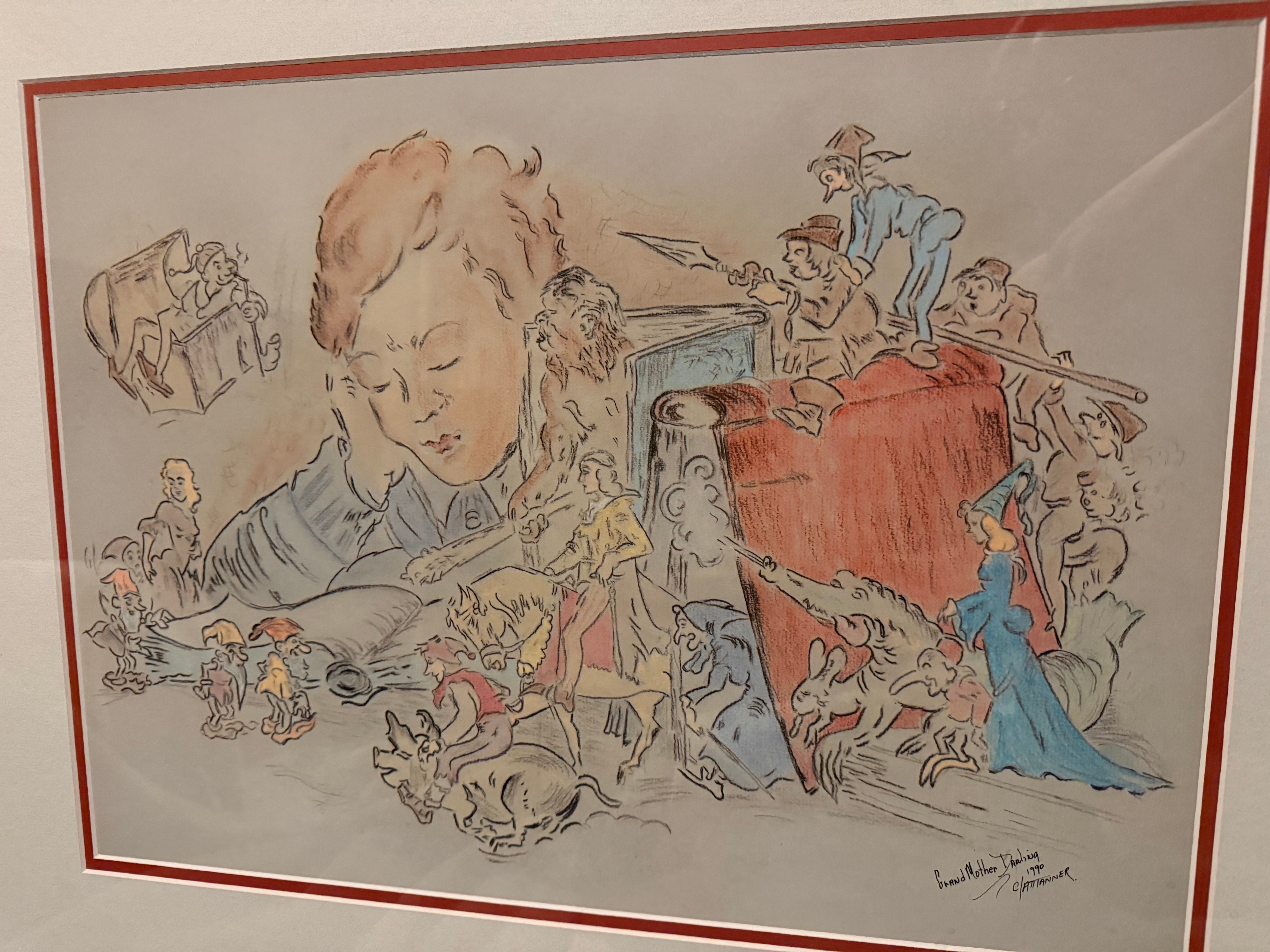
The drawing hung in both of my sons’ nurseries. Later, it hung in my sister’s son’s nursery too.
My children never met my grandmother. They will never hear her voice or know the way it felt to stand in a room with her.
But her hand moved across that paper. She touched it.
She began drawing a little boy while carrying my father inside her, never knowing that decades later the same pencil lines would hang above his grandsons as they slept.
I think about that often because there is something almost impossible about it. My grandmother’s hand left the paper years before my children existed, and somehow her love was already waiting for them when they arrived.
It was already there, waiting.
If I could ask my grandmother one question about that drawing, I think I would ask if she could ever have imagined where it would end up.
I know my children don’t understand the weight of it yet. Right now, it is simply a picture they remember being there.
I understand that too. I once thought Beethoven looked like Darth Vader.
Someday, I hope to give my grandmother’s drawing to my children. I will make a copy of it so they both have it. Maybe it will hang in another nursery. Maybe I’ll stand beneath it and tell the story again. Maybe they won’t understand the weight of it immediately. But I will hold onto it until they are ready.
The picture can wait. Mine did.
For a while, I thought I was collecting my family’s artwork. The plates. The paintings I still hope to find. The drawings I hope someday find their way to me.
But somewhere along the way, I realized I had been collecting something else.
The Beethoven sketch is still hanging in my father’s office. I still look at it. Only now, I can see how much of my life has grown from the questions I first carried away from that room. Maybe my father gave me the lens. Or maybe I arrived already looking for what didn’t fit. Maybe it’s written somewhere in me, another inheritance I can’t hang on a wall. I don’t know where the lens began. I only know my father gave it light.
He never taught me to look away from the question. He answered what I was old enough to ask, and when I came back older, carrying better questions, he gave me more of the story.
Without ever announcing the lesson, he taught me that the first thing I see may not be the whole story. That what looks beautiful from where I am standing may look entirely different from somewhere else. That if I truly want to understand, I may need to ask a better question.
That lens followed me into my classroom. It followed me into advocacy. It changed the way I look at numbers and the weight I allow them to carry. It followed me into my writing.
I built an entire publication around asking what we’re missing before I ever stopped to wonder where I really learned to ask.
Maybe it started in my father’s office, with a teddy bear perched on a printer, a little girl staring at Darth Vader, and a father who took the time to tell her the story.
I thought I was inheriting the artwork. But what if I was inheriting the lens.
That’s the strange and beautiful thing about what we leave behind. We don’t always get to decide which pieces of us someone else will carry. My grandparents couldn’t have known their paintings would make their granddaughter curious about the stories hiding behind the things people choose to keep. My grandmother couldn’t have known a drawing she began while pregnant would someday hang above great-grandchildren she would never meet.
My father’s Hebrew teacher couldn’t have known that a sketch he gave a young boy after his bar mitzvah would spend decades quietly teaching that boy’s daughter about perspective.
Maybe that’s the beauty of it. We leave pieces of ourselves everywhere without ever knowing which ones will keep moving.
A picture passed from one pair of hands to another. A question answered carefully enough that a child returned years later with another. A way of seeing the world offered without ever knowing how far it might travel.
We rarely get to see where these things land.
Maybe years pass before someone looks again. Maybe the meaning changes in their hands. Maybe something we once carried becomes the beginning of a question in someone else.
And maybe that question keeps moving too.
I believe ways of seeing can outlive us.
That somewhere, long after we’ve left the room, something we noticed, something we loved, or simply the way we chose to see the world is still finding its way into someone else’s story.
This is why I write.
I loved this. ❤️ The idea that we can inherit not just artwork, but a way of seeing the world, is so beautiful. ✨
I loved reading this. I enjoyed learning about the stories behind the images that formed part of your childhood. It was also moving to read about the inheritance from your grandmother to your sons. In a way, your grandmother’s art carried her hope for her son and that hope lives on in your sons.